
NIL Go's Deal Review Model Is an Antitrust Case Waiting to Happen

The latest College Sports Commission (“CSC”) NIL Deal Flow Report showed that $89.85M worth of NIL deals have not cleared the NIL Go review process. That’s millions of dollars sitting in the balance with one formula preventing the athletes from getting the money. Without question, that formula will be scrutinized under antitrust law.
The House settlement created new rules that govern NIL. Those rules are enforced by the College Sports Commission in conjunction with Deloitte. They use a platform called NIL Go to review NIL deals. NIL Go uses one formula, built by a group of competitors, to decide what every athlete's deal is worth.

Let me explain how that all works, why it's a legal minefield, and the inevitable litigation that follows.
The Formula
To decide whether an NIL deal is priced fairly, the CSC uses a single model it built in conjunction with Deloitte. At the heart of that model is something called the Range of Compensation (“RoC”). The model considers several factors that are organized into three pillars. Those pillars represent three things: (1) the school's market reach, (2) the athlete's social media reach, and (3) the athlete's performance.
If the pay lands inside the range on even one pillar, the deal clears. But if an NIL deal exceeds the RoC of similarly situated athletes, then the deal isn’t immediately cleared. As of June 30, 2026, there are a total of 1,812 deals worth $89.85M that haven’t cleared.
Laid bare, here’s what it is: one formula, used across all of college sports, that sets what an athlete's work is worth. When the NCAA did it, the courts found antitrust violations.
What Antitrust Actually Is
Antitrust laws exist to stop competitors from teaming up to rig a market instead of competing in it. Price setting among competitors. Rivals aren't supposed to get in a room and agree on prices, carve up customers, or cap what someone can be paid. When they do, the people on the other side of the deal—here, the athletes—get scammed out of their market power.
Now look at who runs the CSC. The College Sports Commission is run by its CEO, Bryan Seeley. CSC is not an independent entity; at least, not independent from the schools and the NCAA. Seeley reports directly to a board composed of the commissioners of the P4 conferences (the ACC, Big Ten, Big 12, and SEC). The CSC also has a president, Patrick Crawford, who serves as an associate athletic director at Purdue University.
Colleges and conferences compete against each other for players. Acting through one body, using one formula to decide how much any athlete can earn, is a group of competitors agreeing on the price of labor. That's the exact arrangement antitrust law was written to test. And, yes, it will eventually be tested.
The Rule of Reason
Not every agreement among competitors is per se illegal. Courts sort them into two piles. A few—blatant price-fixing among rivals—are illegal on sight. Those are DOA. Most get judged by what's called the "rule of reason." That’s where a court weighs the harm to competition against any genuine benefit. Then the court asks whether there was a less restrictive way to get that benefit.
How the Rule of Reason Relates to the NCAA & CSC
For decades, the NCAA avoided standard Rule of Reason scrutiny under antitrust laws because courts historically deferred to the organization's definition of "amateurism." Under the Rule of Reason, a defendant can justify a restraint on trade if they prove it has a pro-competitive benefit. The NCAA argued that its restrictions on athlete pay were not meant to suppress wages, but to preserve "amateurism."
Judges accepted the NCAA's argument that strict no-pay rules preserved consumer demand and maintained a necessary distinction between academic and professional sports.
Over a series of court cases, that argument died a death of a thousand cuts. Eventually, the Supreme Court delivered a fatal unanimous blow in 2021 in NCAA v. Alston: The NCAA is a commercial enterprise and no longer gets a free pass. From hence forth, the NCAA’s limits on athlete pay will be judged under the standard rule of reason—the demanding version of the test. Justice Kavanaugh said as much in a concurring opinion.
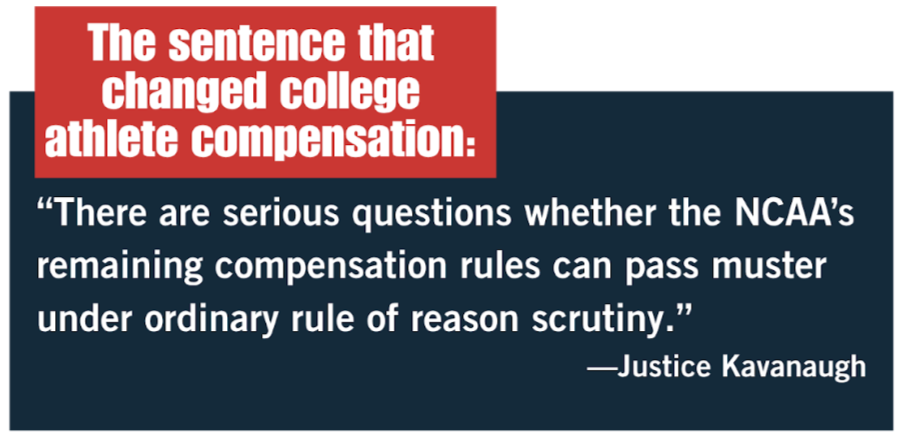
The CSC is overseen by the P4 conferences, which are members of the NCAA. While there has been talk of some of these major conferences potentially splitting off to form their own governing body, currently, they are still part of the NCAA. And because of that, the courts are likely to judge the CSC’s actions under the standard rule of reason when examining their RoC and the model used to cap or restrict NIL deals.
The CSC's Defenses
The CSC isn't defenseless in all of this. Its best argument is that the model grew out of the House settlement. The players were a party to that case, agreed to the settlement, and a federal court approved it. Conduct a court blessed is harder to attack than a back-room deal. And if Congress passes the Protect College Sports Act, Section 118 hands the NCAA and conferences a shield from antitrust suits for enforcing the rev-share cap and its core rules. Although, Alabama and Auburn don’t feel the Act provides them with enough protection from antitrust suits.
The Weaknesses in Those Defenses
Both of those defenses have holes. Court approval of a settlement isn't a permanent hall pass—it doesn't immunize everything the settlement covers, forever and always. And Alabama and Auburn are right; that congressional shield is narrower than it sounds. It covers specific, listed conduct, and the bill says plainly that it doesn't apply to any situation beyond what’s on that list.
That raises the obvious question: does the Act’s shield cover the pricing model? Section 118 protects enforcing the rev-share cap—the ceiling on total dollars a school can share. That’s the pay-for-play college salary cap.
But the CSC’s pricing model is a different animal. It doesn't cap any total; it sets an individual price on each deal through its pillars and model. If the Act’s shield protects the rev-share cap but not CSC’s NIL deal review formula, the model stays exposed even if the Act passes.
The Practical Effects
Athletes are already pressing antitrust theories against the NCAA's enforcement measures under the House settlement (See, among others, Ili v. NCAA). And if we've learned one thing, it's that college athletes will sue. The moment you have competitors using one formula to cap what workers earn, you've built exactly what antitrust law exists to scrutinize.
For athletes, I’d make sure any NIL deal is reasonably priced, but be ready to defend against a denial from the CSC. It’s one thing for the CSC to reject an NIL deal, it’s another to put your eligibility on the line.
For schools, we all know a mix of rev-share and promised NIL dollars are used to secure athletes. That NIL portion is on riskier ground than downtown San Francisco. It’s shaky! Be ready to defend those deals in court, where all of this is headed, as we’ve continuously seen.


rổ phim hôm bữa mình thấy bạn share nên tò mò vào nghía thử cho biết thôi. Mình không có thời gian ngồi lọc từng thể loại hay xem hết kho phim, chủ yếu xem giao diện có dễ dùng không. Vừa vào thấy cách sắp xếp cũng ổn, nhìn một cái là biết chỗ lướt phim mới với mấy mục phim hay, không phải bấm qua lại nhiều. Kéo xuống thì các phim hiện dạng ô thẻ nên nhìn khá thoáng, không bị nhồi chữ. Mình thích nhất là họ để luôn nhãn chất lượng kiểu HD 4K ngay gần thông tin phim, khỏi phải mở ra rồi mới biết. Menu với tiêu đề chuyên mục chia theo từng…
https://soicaulodechuan.net/ mình thấy bạn bè nhắc mấy lần nên cũng bấm vào nghía thử cho biết. Không phải kiểu vào đọc kỹ từng thứ đâu, mình chỉ xem giao diện với cách họ trình bày có dễ nhìn không. Ấn tượng ban đầu là trang nhìn khá sáng sủa, khoảng trống vừa đủ nên không bị ngộp chữ. Mấy phần thông tin được chia thành từng khung riêng nên kéo xuống vẫn biết mình đang xem đoạn nào, không bị lẫn lộn. Mình cũng thích cách họ canh hàng/cột khá thẳng, kiểu nhìn qua là bắt được số liệu chứ không phải nheo mắt. Menu đặt chỗ dễ thấy nên đổi qua lại vài mục cũng nhanh, không phải mò,…